building fulfilling lives
fostering PSYCHOLOGICAL FLEXIBILITY
meet peyton


Scroll to learn more about our approach
Aligned Performance Coaching Founder, Peyton Pesavento Johnston, grew up in a sports-oriented household and played both basketball and volleyball before ultimately deciding to pursue tennis full-time. As a junior, she predominately competed in USTA tournaments across the United States while also participating in select ITF events. Peyton attended Wake Forest University (WFU) on a full athletic scholarship, playing in the ACC conference, ACC tournament, and NCAA championships from 2018-2022. During her collegiate career, she earned multiple ITA Scholar-Athlete honors and achieved career-high national rankings of No. 98 in singles and No. 46 in doubles.
While competing, Peyton studied Health & Exercise Science and Psychology, graduating Magna Cum Laude. She was originally interested in physical health, but became intrigued by the psychological aspect of sports while competing at a Division I program. She became a leader within the WFU Sport Psychology group and delivered workshops to female teams as a part of the Female Athlete Body Project.
After graduating, Peyton worked as a medical assistant before pursuing a master’s degree in Performance Psychology at the University of Edinburgh in Scotland. Here, she learned how to consult with athletes and other stakeholders regarding numerous performance-related issues. She also developed research surrounding retirement from sport through the lens of athletic identity and coping processes.
Since completing her degree in 2024, Peyton has worked and volunteered with individuals and teams in multiple sports such as tennis, golf, and even rally driving! She is currently completing the criteria towards the CMPC (Certified Mental Performance Certification), the gold-standard within sport psychology and mental performance. Peyton is also a professional member of the AASP (Association for Applied Sport Psychology) and an NASM-CPT (Certified Personal Trainer). And she is the Co-host of the Yips and Giggles podcast!
the apc approach
What makes Aligned Performance Coaching different?
Aligned Performance Coaching concentrates on developing athletes through ACT (as explained above), but also emphasizes practicality by combining ACT with psychological skills training (e.g., goal-setting, self-talk, mindfulness, pre-performance routines, etc.). This is not a sit back and have a chat kind of program. My goal is for athletes to take charge in everything they do, including their mental performance work. With this idea, they can build self-awareness which can help them in every aspect of their career whether that be psychological, physical, technical, or tactical. In addition, our main programs focus on important transitions in sporting careers. Major milestones, new teams, stepping up to the next level, retirement… these are all stages in which athletes can enhance their skills, well-being, and character to ultimately work towards a more fulfilling career and life!
What is acceptance and commitment therapy?
Acceptance and Commitment Therapy (ACT) is considered a behavioral-based therapy because it is all about taking action. Specifically, taking action in a way that is guided by your chosen, core values. Without getting too philosophical, we use ACT to understand and work towards what really matters, which is important in sport and everyday life!
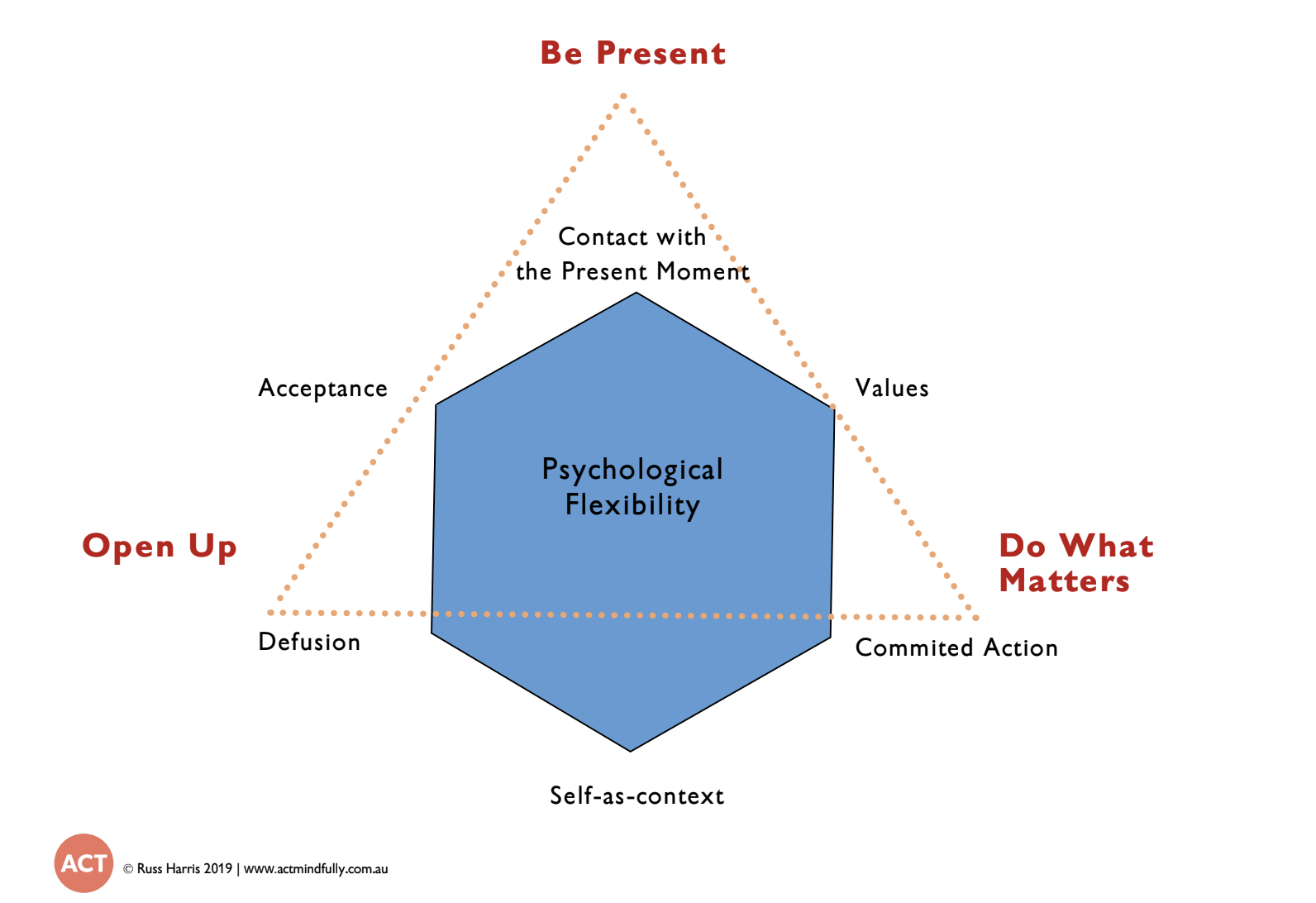
Six Core Processes of ACT
In the diagram above, you will see the core processes of ACT, which can help athletes work towards psychological flexibility. What is psychological flexibility, you might ask? It is “…the ability to respond in an adaptive, flexible, and effective manner to changing situations” (Huelsmann & Hegarty, 2020). In short, it means to be present, do what matters, and open up. So, let’s take a look at each core process and see how we can apply it to sport to give you an idea of how this works.
Contact with the Present Moment
If an athlete is stuck daydreaming at practice or is filled with worry during a match/game, then they have inflexible attention. This could result in distraction and performance mistakes. In this case, it would be ideal to focus on the first point on the hexaflex model above: Contact with the Present Moment. Here, we would develop the ability to concentrate on what is happening in the here and now rather than focusing on the past and future.
Values
Let’s say an athlete is lacking motivation or is getting ready to make a big transition into a sporting endeavor at a higher level. It’s so important to figure out the “why”. Why are you playing this sport? What is the purpose behind it? In this case, we would take a look at the athlete’s values, and find ways to make sure they are living by them every day to increase their motivation or be ready for a new challenge.
Committed Action
Once an athlete has determined their core values they can then take the next step to committed action, which is always a crowd favorite because it is super practical! Committed action can be many things: goal-setting, problem-solving, skills training, etc. But the most important part is aligning these actions with their values. For example, if a collegiate athlete chose to focus on “being dedicated” as one of their values, what would that look like through committed action?
→ Showing up on time, not skipping workouts, getting ahead in their studies so they can focus on competition… the list goes on! These actions are what ACT practitioners like to call “workable”, meaning these behaviors are helping that athlete build the life they want. An “unworkable” action might be sleeping through an alarm or procrastinating to the point where it impacts your play.
Self-as-Context
Self-as-context can be a tricky one to get down, but I like to think of it as the ability to “notice” your thoughts and feelings, rather than be “controlled” or “defined” by them. The opposite of self-as-context is adhering to very rigid beliefs about yourself and completely fusing your identity with your thoughts. Ever heard of “you are what you eat”? This is kind of like “you are what you think.” This way of thinking could ultimately contribute to performance anxiety, lack of confidence, and all the things an athlete does not want to feel. Let’s say an athlete is thinking “I am a failure” or “I am a disappointment” and they truly believe they are their thoughts (i.e. a failure and a disappointment). It is crucial to work towards that “self-as-context” in order to change the athlete’s relationship with these thoughts and create an “observing self” that takes a different perspective and sees the thought as passing.
Defusion
Defusion can be incorporated throughout ACT, and is an extremely helpful tool for specific thoughts and feelings of doubt, judgment, and failure. For instance, if an athlete gives all of their attention to the thought of “I’m terrible at this shot,” they might try to avoid the shot entirely, decreasing their performance outcomes. By utilizing the defusion technique, we can reduce the power of these thoughts by taking a step back and creating distance between the athlete and their “unworkable” thoughts.
Acceptance
The final core process we will look at is acceptance, and in many cases, it goes hand-in-hand with defusion. Has anyone ever told you “just stop thinking about it?” Were you able to stop thinking about whatever it was you were thinking about? That’s what I thought. Many athletes experience nerves before competition - that’s human and completely normal! But sometimes, we let those feelings and thoughts about our nerves completely take over and impact our performance negatively. Rather than obsessing over or putting all of our attention towards trying to stop these nerves, this process allows the athlete to accept nerves as part of competing without putting more energy into combatting unhelpful thoughts and feelings. There are lots of techniques which foster acceptance such as mindfulness or focused engagement.